From Classroom Curiosity to Team-Wide Wonder
Turn your Yelagiri educational tour, student camp, corporate offsite or employee gathering into a guided journey across the real night sky.
Stargazing Yelagiri creates customised telescope experiences for schools, colleges, institutions and corporate teams. Participants observe suitable celestial objects, learn to navigate the sky and understand astronomy through clear explanations, interaction and shared discovery.
For students, it transforms textbook ideas into real observation.
For corporate teams, it creates a refreshing shared experience beyond meeting rooms, presentations and routine resort activities.
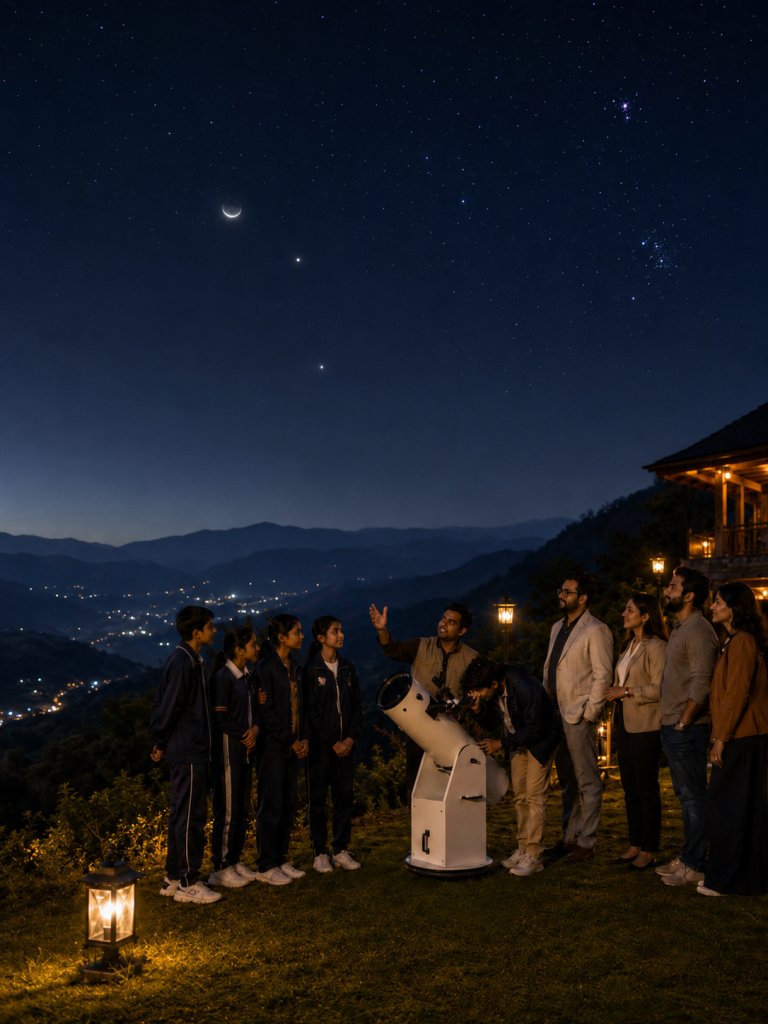
What is a Group Stargazing Program in Yelagiri?
A group stargazing program is a structured astronomy experience combining a guided sky introduction, telescope observation, accessible scientific explanation and participant interaction.
The content and event flow can be adapted for:
- School educational tours
- Student camps
- Astronomy or science-club activities
- College groups
- Teacher and parent gatherings
- Corporate offsites
- Employee-engagement evenings
- Leadership retreats
- Institutional events
- Resort-based group programs
The program is designed around the audience, group size, venue, available duration and sky expected on the event date.
Stargazing Programs for Schools Help Students Experience the Astronomy They Study
Astronomy is often introduced through diagrams, chapters, photographs and videos.
A telescope session gives students the opportunity to connect those ideas with the real sky.
Depending on the date and conditions, students may observe the Moon’s terrain, visible planets, prominent stars, stellar pairs, star clusters or seasonal constellations. They can also learn how telescopes collect light and why celestial objects appear different through an eyepiece than in processed space images.
The objective is to encourage observation, questioning and scientific curiosity—not simply to memorise more facts.
What Students Can Learn?
A school stargazing session may introduce age-appropriate ideas such as:
- How to identify directions using the night sky
- The difference between a star and a planet
- Why the Moon changes phase
- What lunar craters and darker plains represent
- How a telescope collects and focuses light
- Why planets are visible only during particular periods
- How constellations help people map the sky
- The true scale of the Solar System
- The distance between stars
- Why dark adaptation and lighting matter
- How astronomers observe and record the sky
- The difference between visual observation and processed astronomy images
The exact subject depth can be adjusted for primary students, secondary students, higher-secondary groups or college participants.
An Interactive School Astronomy Experience
The program can include:
Guided Sky Orientation
Students learn the visible directions, important stars and seasonal sky patterns.
Telescope Demonstration
The guide introduces the telescope, its main parts, basic optical function and safe usage.
Organised Observation
Students observe selected celestial targets through a managed queue or batch system.
Scientific Explanation
Each target is discussed through clear and age-appropriate astronomy.
Questions and Discussion
Students are encouraged to ask about planets, stars, space travel, black holes, satellites, the Moon and current areas of curiosity.
Optional Topic Focus
Where discussed in advance, the session may place additional emphasis on a relevant theme such as the Moon, the Solar System, constellations, telescope basics or observational astronomy.
Stargazing for Corporate Offsites: Give Your Team Something New to Talk About
Many corporate offsites follow a familiar pattern: meetings, presentations, indoor games, dinner and music.
Stargazing offers a different rhythm.
Participants step outdoors, look away from their screens and share a live experience that does not depend on hierarchy, department or professional background.
Everyone begins with the same question: “What are we looking at?”
That shared curiosity helps create natural conversation and makes the evening feel less like another scheduled corporate activity.
Suitable for Corporate Events Such As
- Employee-engagement programs
- Corporate offsites
- Leadership retreats
- Team outings
- Annual gatherings
- Reward and recognition trips
- Department getaways
- Client or partner evenings
- Resort conferences
- Wellness-oriented group programs
- Informal networking evenings
The session can be planned as a primary evening activity or incorporated into a wider resort itinerary.
How Does Stargazing Support Team Engagement?
A guided night-sky experience gives teams:
A Shared Point of Discovery
Participants experience the same telescope views and sky stories, creating an immediate common conversation.
Perspective
Learning about astronomical distances and scales can create a memorable shift away from everyday workplace concerns.
Screen-Light Time Outdoors
The session provides a natural break from laptops, meeting rooms, phones and presentation-heavy schedules.
Natural Curiosity
Questions emerge organically, allowing participants to engage without the forced atmosphere of a conventional icebreaker.
Inclusive Participation
No sporting ability, specialist knowledge or astronomy background is required.
Stargazing Venue Requirements in Yelagiri
A suitable event area should provide:
- Safe and authorised participant access
- A stable telescope surface
- Useful open-sky visibility
- Enough space for group movement
- Controlled or reducible nearby lighting
- Distance from vehicle headlights where possible
- A practical assembly area
- Supervision for students
- Venue permission for equipment setup
Trees, buildings, slopes, walls, mist and decorative lighting can influence what is visible from a property.
For large groups, an advance venue discussion or visual review may be required.

Bring the Universe Into Your Yelagiri Itinerary
For students, the sky can become a living science laboratory.
For employees, it can become a shared moment of curiosity beyond the usual offsite schedule.
For every participant, it is an opportunity to see real celestial light through a telescope and understand that astronomy is not confined to textbooks, screens or distant observatories.
Stargazing for School & Corporates in Yelagiri Hills – Frequently Asked Questions
Can the program be conducted at our school, resort or corporate offsite venue?
Yes, subject to permission, safe participant access, open-sky visibility, a stable telescope area and manageable local lighting. Share the venue details so the observation area and event flow can be assessed.
Is the school session suitable for different age groups?
Yes. The language, concepts and interaction can be adapted to the students’ age or grade range. Share the class levels and learning objective so the session can balance scientific accuracy with age-appropriate explanation.
How many students or employees can participate?
The session plan depends on group size, participant age, available duration and venue layout. Larger groups may need timed batches, a longer program or additional viewing arrangements, which are proposed after reviewing the enquiry.
Can corporate stargazing work as a team-engagement activity?
Yes. A guided sky tour creates a shared, screen-light experience that can fit corporate offsites, leadership retreats, employee gatherings and informal team evenings. The format can be adjusted around the event schedule and group profile.
What can participants observe through the telescope?
Targets vary with the date, season and sky conditions. Possible observations may include lunar surface features, visible planets, bright stars, double stars, star clusters and selected seasonal constellations. No celestial object is guaranteed.
What is the weather contingency for a group event?
Because telescope observation requires usable sky conditions, cloud, mist and rain are reviewed close to the event. Depending on the forecast and booking terms, the plan may involve adjusted timing, a modified astronomy interaction or rescheduling.