

Table of Contents
Quick Bites Summary:
Accessible Dark-Sky Escape: Rising 1,110 meters above sea level, Yelagiri Hills offers a Bortle Class 4 dark-sky haven within a 3- to 4-hour drive (160 to 220 km) from Bengaluru and Chennai.
3-Layered Observing Flow: A true stargazing session builds depth sequentially—combining naked-eye constellation tracing, binocular star-field sweeps, and high-aperture tracking telescope deep-sky views.
Location & Property Selection are Critical: While peripheral zones like Nilavoor Cliff and Mangalam Village offer dark horizons, central Athanavur and lit resorts wash out views. Property choice, lighting control, and open sky access dictate the experience.
Synergy with Kavalur: The Vainu Bappu Observatory (home to the 2.3m VBT) sits roughly 55 km away in the Javadi Hills, making its Saturday public program an ideal daytime prelude to a Yelagiri night-sky session.
Depending on the date and conditions, visitors may observe the Moon, visible planets, bright stars, constellations, double stars, star clusters and seasonal Milky Way skies. New Moon is useful for faint stars and Milky Way viewing, while crescent and quarter-Moon nights can produce exceptional lunar telescope views. Stargazing Yelagiri offers personalised guided telescope experiences for couples, families, children, friends, schools and corporate groups.
Yelagiri Hills: South India’s Accessible Astrotourism Haven
For urban dwellers in Chennai and Bangalore, heavy light pollution 1.0 to 3.0 mcd/m^2 hides all but the moon and brightest planets. Finding true dark skies usually demands exhaustive travel.
| Chennai / Bangalore | Yelagiri Hills Plateau |
| Bortle Class 8/9 | Bortle Class 4 |
| Streetlights & Haze | 1110 Meters Elevation |
| Faint Stars Invisible | Milky Way Core Visible |
Yelagiri Hills transforms this equation. Approached via a winding ghat road featuring 14 hairpin bends, this plateau in Tamil Nadu’s Tirupathur district rises to 1,110 meters in the Eastern Ghats. It sits roughly 160 km from Bangalore and 224 km from Chennai, placing an accessible dark-sky sanctuary within reach for a weekend getaway.
Ascending the plateau leaves behind low-altitude humidity, particulate haze, and heavy urban light domes. Under a Bortle Class 4 (Suburban/Rural Transition) sky, thousands of stars, faint nebulae, and the luminous arch of the Milky Way become visible to the eye.
Anatomy of Yelagiri’s Night Sky: Altitude, Seeing, and Bortle 4 Scale
Three environmental factors work together to elevate Yelagiri’s night sky:
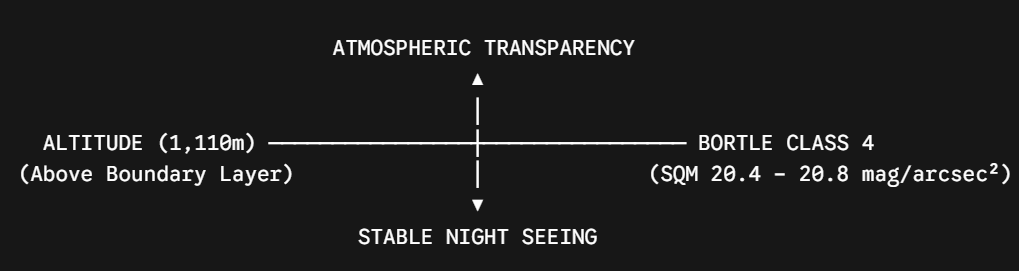
1. The Elevation Advantage 1,110 m
Light pollution scatters off low-altitude moisture, aerosol particles, and dust suspended near ground level (Mie scattering). By ascending 1,110 meters above sea level, you rise above this boundary layer. The air becomes cooler, thinner, and significantly drier, boosting atmospheric transparency.
2. Astronomical “Seeing” and Thermal Stability
“Seeing” defines optical turbulence in the atmosphere. Coastal cities suffer from heavy, warm air currents that make stars twinkle violently and blur telescope images. Yelagiri’s high-altitude climate cools steadily after sunset. This thermal equilibrium stabilizes air layers, allowing crisp, high-magnification views of planetary features like Saturn’s Cassini Division or Jupiter’s atmospheric bands.
3. Quantitative Sky Metrics
Sky Quality Meter (SQM) readings across dark pockets of the Yelagiri plateau range from 20.4 to 20.8 mag/arcsec}^2.
- Naked-Eye Limiting Magnitude (V_m): Reaches 6.0 to 6.3 on moonless nights.
- Zenith Conditions: Deep, high-contrast overhead dark sky with dense star fields.
- Horizon Profile: Faint, localized light domes hover over distant horizons toward regional valley hubs (Vaniyambadi to the northwest, Tirupattur to the southeast), but overhead sky and southern vectors remain dark.

Transform Your Weekend into a Private Journey Through the Stars
Don’t spend your evening struggling with star chart apps or gazing from light-polluted hotel balconies. Experience Yelagiri’s true dark sky with Stargazing Yelagiri.
What Can You Realistically See? Visual Reality vs. Astrophotography
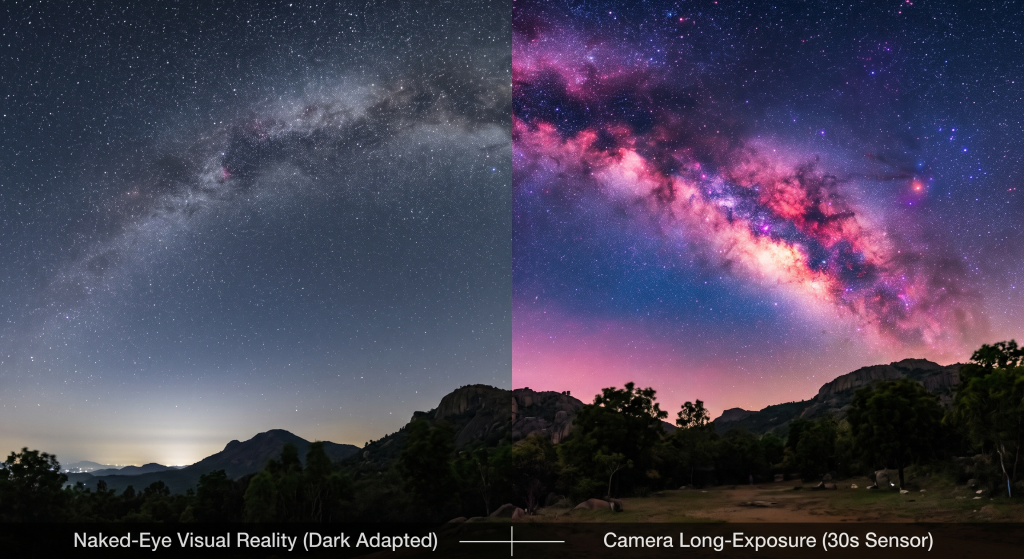
Setting accurate expectations transforms a good stargazing night into an unforgettable one. Modern astrophotography relies on sensors accumulating light over long exposures 15 — 30 seconds, revealing saturated pinks, magentas, and deep blues.
Human vision works differently under low-light conditions. Human rod cells (scotopic vision) process spatial contrast and gray tones rather than vivid color.
| Celestial Target | Naked-Eye View | 10×50 Binoculars | Tracking Telescope |
| The Milky Way Core | Pale, silvery cloud arch with visible dark dust lanes | Dense fields of resolved background stars and glow | Broad dust lanes and rich background star fields |
| Jupiter & Saturn | Very bright points of light | Jupiter’s 4 Galilean moons visible as points | Saturn’s rings & Cassini division; Jupiter’s cloud belts |
| Nebulae ($M42, M8$) | Faint fuzzy patches in sky | Glowing gas clouds with surrounding stars | Ethereal gray-green structure with central trapezium stars |
| Star Clusters ($M45, M13$) | Distinct star groups or glowing knots | Dozens of individual bright stars resolved | Hundreds of pin-point stars sparkling across the core |
Top Micro-Locations Across the Plateau: Dark Pockets vs. Glare Traps
The Yelagiri plateau is not uniformly dark. Local business districts, road streetlights, and resort floodlights create localized glare pools. Finding high-contrast views requires selecting the right micro-location:
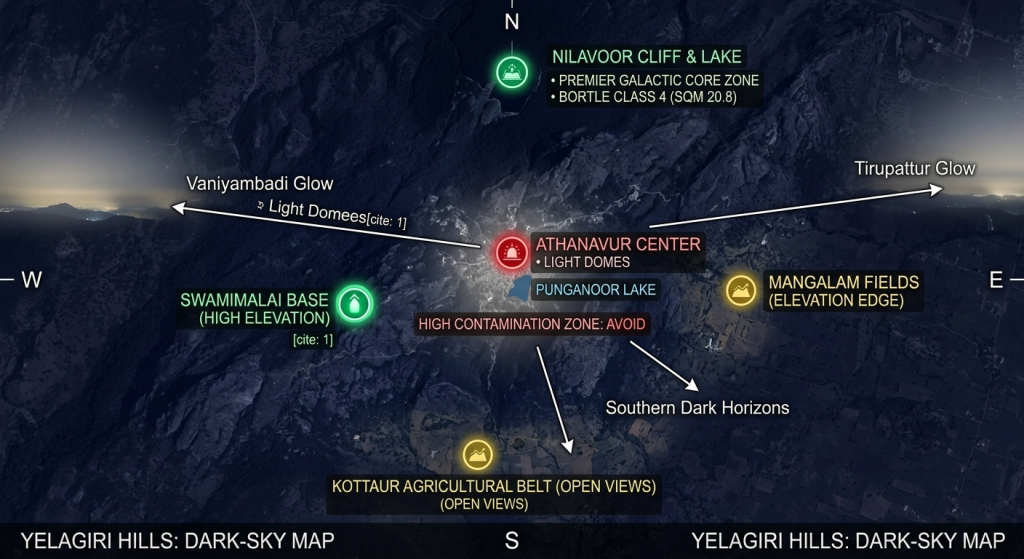
1. Nilavoor Cliff & Lake Outskirts (Dark Sky Rating: 9.5/10)
Situated at the northern point of the plateau, Nilavoor sits far from commercial centers. The open terrain features wide agricultural fields and low ridges, providing clean views of the zenith and southern horizons—the premier location for viewing the Galactic Core.
2. Mangalam Village & Swamimalai Base (Dark Sky Rating: 9.0/10)
Located near the foot of Swamimalai Peak, Mangalam has minimal street lighting. Mountain ridges shield the area from light spill originating in valley towns, creating a dark-sky envelope ideal for wide-field astrophotography.
3. Kottaur Agricultural Belt (Dark Sky Rating: 8.5/10)
Located along the southeastern edge, Kottaur features broad agricultural land away from resort pockets. The flat, open horizon works well for tracking low-altitude constellations, planetary conjunctions, and meteor showers.
4. Athanavur Central & Punganoor Lake (Dark Sky Rating: 3.0/10 — Avoid)
Athanavur serves as Yelagiri’s commercial core, filled with bright storefronts, traffic, and unshielded streetlights. Punganoor Lake parkways feature unshielded lighting that washes out night vision. Avoid setting up optics in these central hubs.
Why Accommodation and Property Setup Matter As Much As the Destination
A resort being located in Yelagiri does not automatically make its grounds suitable for telescope observation. Unshielded property lights, tall tree canopies, multi-story buildings, and traffic glare can ruin night-sky views.
| SUITABLE OBSERVING SITE | UNSUITABLE OBSERVING SITE |
| Open sky view (low horizon) | Tall trees & building blocks |
| Flat, stable lawn/terrace | High LED floodlights & glare |
| Dim red-light control | Constant vehicle movement |
| Safe access for guests | Uncontrolled white lighting |
Key Venue Requirements for Stargazing:
- Unobstructed Horizons: Access to open lawns, terraces, villa gardens, or open campsite clearings away from tall structures.
- Lighting Management: Permission to douse non-essential garden, flood, and pathway lighting during your session.
- Safety & Stability: Level ground that allows safe movement for children and seniors while providing a stable foundation for high-magnification optics.
When planning your trip, share your accommodation name with your stargazing guide ahead of time. This ensures the venue layout, sky visibility, and lighting setup can be evaluated before you arrive.
Integrating Vainu Bappu Observatory (Kavalur) into Your Trip
A weekend astronomy getaway to Yelagiri can be paired with a visit to the historic Vainu Bappu Observatory (VBO), operated by the Indian Institute of Astrophysics (IIA).
Essential Visitor Logistics:
- Location & Travel Time: Located in Kavalur within the Javadi Hills, roughly 55 km (1.5 to 2 hours drive) from Yelagiri via Alangayam.
- Public Visitor Day: Public outreach programs run exclusively on Saturdays. Daytime entry to tour the telescope dome is typically open from 2:00 PM to 4:00 PM.
- Primary Attraction: Visitors can tour the dome housing the famous 2.3-meter Vainu Bappu Telescope (VBT)—historically one of Asia’s largest optical research instruments.
- Evening Public Session: On clear Saturday evenings, observatory staff host public sky observation using visitor telescopes between 6:30 PM and 8:30 PM.
Ideal Saturday Itinerary:
Drive down the ghat road from Yelagiri on Saturday afternoon, visit the Kavalur Observatory dome and exhibits between 2:30 PM and 5:00 PM, and return to your high-altitude Yelagiri site by 8:00 PM for a private stargazing session.
The 3-Layered Observing Flow: Naked Eye, Binoculars, and Telescopes
A guided stargazing experience should never feel like standing in an unexplained line to look through an eyepiece. The most rewarding sessions build understanding through three distinct layers:
Layer 1: Naked-Eye Sky Exploration
The human eye provides the widest possible view of the night sky 180* degree field. It is the best tool for learning cardinal directions, tracing constellations, tracking satellites, spotting meteors, and appreciating the wide arch of the Milky Way.
Layer 2: Astronomy-Grade Binoculars (10 X 50 or 15 X 70)
Binoculars bridge wide-field viewing and telescope magnification. Providing a wide 5* to 7* field of view and natural two-eyed depth perception, they excel at sweeping dense star fields:
- Summer Highlights: The Lagoon Nebula ($M8$), Trifid Nebula ($M20$), and Ptolemy Cluster ($M7$).
- Winter Highlights: The Pleiades Cluster ($M45$) and the Hyades.
Layer 3: High-Aperture Tracking Telescopes (8 to 10 inches)
Telescopes gather light and magnify distant targets. An 8-inch mirror gathers over 840 times more light than the human eye, bringing fine details into focus:
- Planetary Detail: Saturn’s ring structure, Titan, and Jupiter’s cloud belts.
- Lunar Features: Sunlit crater walls, mountain peaks, and deep shadows along the lunar terminator.
- Deep Space: Sparking globular clusters like $M13$ and gas structures in the Orion Nebula ($M42$).
Designed Around Your Group: Couples, Families, and Corporate Teams
hether you are planning a romantic anniversary getaway, an engaging family holiday, or a structured corporate retreat, Stargazing Yelagiri tailors the stargazing flow to your group size and age mix.
Seasonality, Moon Phases, and Weather Planning
Planning a successful dark-sky getaway requires aligning your travel dates with sky conditions.
| JAN to APR | MAY to AUG | SEP to DEC |
| Clear, Dry Winter/Spring | Galactic Core Prime | Northeast Monsoon Interruption |
| Highest Transparency | Monsoon Gaps & Humidity | Unreliable Cloud Cover (Oct-Nov) |
| Excellent Planetary Seeing | Best Milky Way Viewing | Clear Winter Sky Returns (Late Dec) |
The Moon Phase Rule
The moon is the brightest natural light source in the night sky.
For Lunar Stargazing: A Crescent or Quarter Moon offers superior views through a telescope. Sunlight striking lunar topography at an angle casts long shadows, making craters and mountain ridges stand out clearly.
For Milky Way & Deep Space: Schedule trips during the New Moon phase or when the moon is less than 20% illuminated.
Seasonal Sky Guide
- January to April (Peak Sky Clarity): Dry air, stable seeing, and clear skies. Outstanding conditions for viewing Orion, Andromeda, and bright planets.
- May to August (Milky Way Season): The Galactic Core sits high overhead. Passing Southwest Monsoon clouds occur, but post-rain spells offer exceptionally dark skies.
- September to November (Northeast Monsoon): Heavy cloud cover and rain across Tamil Nadu. Sky conditions are unpredictable.
- December (Winter Stars & Meteors): Clear air returns, headlined by the peak of the Geminid Meteor Shower in mid-December.
What Happens During a Guided Session & Field Etiquette
A professional guided session balances rich learning with proper dark-sky etiquette:
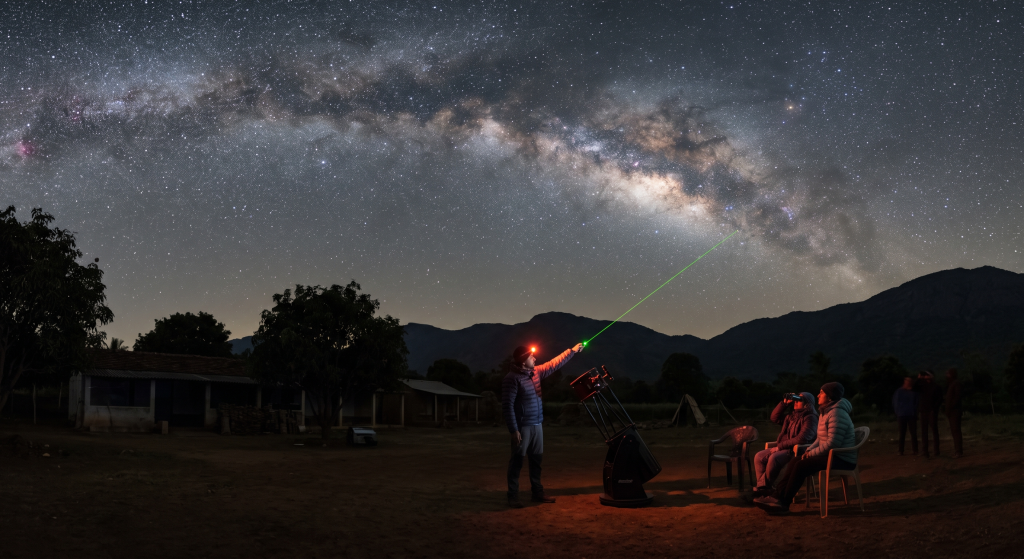
What to Expect During Your Session:
- Sunset Check: The setup area is cleared, directions are marked, and optics are thermally stabilized.
- Orientation & Constellation Tour: Using a high-powered green laser, your guide outlines bright stars, constellations, visible planets, and directional anchors.
- Paced Telescope Observing: Targets are introduced sequentially. Your guide explains what you are looking at, its real distance, and the science behind the visual image.
Essential Field Rules:
- Preserve Dark Adaptation: Red flashlights should be used exclusively. White light breaks down rhodopsin in the eye, resetting dark adaptation.
- Manage Screen Brightness: Dim mobile screens and avoid flash photography near telescope observers.
- Handle Optics Responsibly: Avoid touching telescope lenses, mirrors, or tracking mounts during observation.
- Stay Comfortable: Night temperatures in Yelagiri drop to 12*C 15*C in winter. Bring a warm jacket, closed footwear, and drinking water.
Let the sky become part of your Yelagiri story
A Yelagiri trip can include the drive, the hills, the lake, viewpoints, food and time with people who matter.
Stargazing adds something fundamentally different.
It may be the first time your child sees Jupiter’s moons. The first time your partner recognises a constellation. The moment Saturn stops being a textbook illustration and becomes a real world floating inside the eyepiece.
Or it may simply be the moment the group becomes quiet, looks upward and realises how much of the universe usually goes unnoticed.
Frequently Asked Questions (FAQs)
Can we bring personal binoculars or telescopes to the session?
Yes. Guests are welcome to bring personal binoculars to complement the guided session. If bringing a personal telescope, notify your guide in advance so adequate space and assembly time can be allocated alongside the primary tracking instrument.
Is stargazing suitable for young children and senior citizens?
Yes, provided the venue offers flat, safe access. Children should be supervised around optical equipment. Providing chairs ensures senior guests can comfortably view targets through low-profile or adjusted eyepieces.
How do sessions adapt to passing cloud cover?
Patchy clouds often leave open sky windows for viewing bright targets like the Moon, planets, or double stars. If widespread cloud cover develops, guides adapt by focusing on open sky quadrants or pausing until conditions improve.
Can guided sessions be conducted entirely in Tamil?
Yes. Sessions can be delivered in Tamil, English, or a natural bilingual mix, ensuring everyone can participate, ask questions, and enjoy the experience comfortably.
What is the nearest railway station for a Yelagiri stargazing trip?
Jolarpettai Junction is the most practical major rail connection for Yelagiri. Travellers should arrange onward transport to their accommodation in advance, particularly when arriving in the evening. Late-night availability, luggage, group size and the hill-road journey should be considered. Reaching the property before sunset is preferable when a telescope session is planned for the same night.
Can visitors take photographs through the telescope?
Simple phone photographs of the Moon and occasionally bright planets may be possible when conditions, equipment alignment and available session time permit. Results vary considerably and should not be treated as guaranteed professional astrophotography. A manual Dobsonian is designed primarily for visual observation and is not the same as a motorised equatorial system used for long-exposure deep-sky imaging.
Leave a Reply